

Sleep
The 3am alarm: 6 ways stress hormones wake you at night, and what to do about each one
You wake at the same small hour most nights. Heart going. Mind instantly loud. That is not bad luck, and it is not a bladder with opinions. There is a hormone with a schedule behind it, and once you can see the schedule, the fix stops being mysterious. Here is what is happening, in the order that matters.
Cortisol runs on a clock, and it rises before dawn
Cortisol is the body's readiness hormone, and it moves through the night on a curve. It sits at its lowest around midnight, stays low through the first sleep cycles, then begins climbing in the small hours so that it peaks shortly after you get up. That climb is normal. It is how a body arranges to be awake at eight.
The trouble starts when the climb begins too early or too steeply. Sleep in the second half of the night is lighter by design, so a body that is already ramping up for morning does not need much of a push to break the surface. The 3am wake-up sits exactly where the curve turns upward. That is not a coincidence. It is the schedule.
What to know Waking near 3am is the curve's most vulnerable point, not a random failure. You are not broken. You are surfacing where the tide turns.
A stressed system fires the alarm early and steep
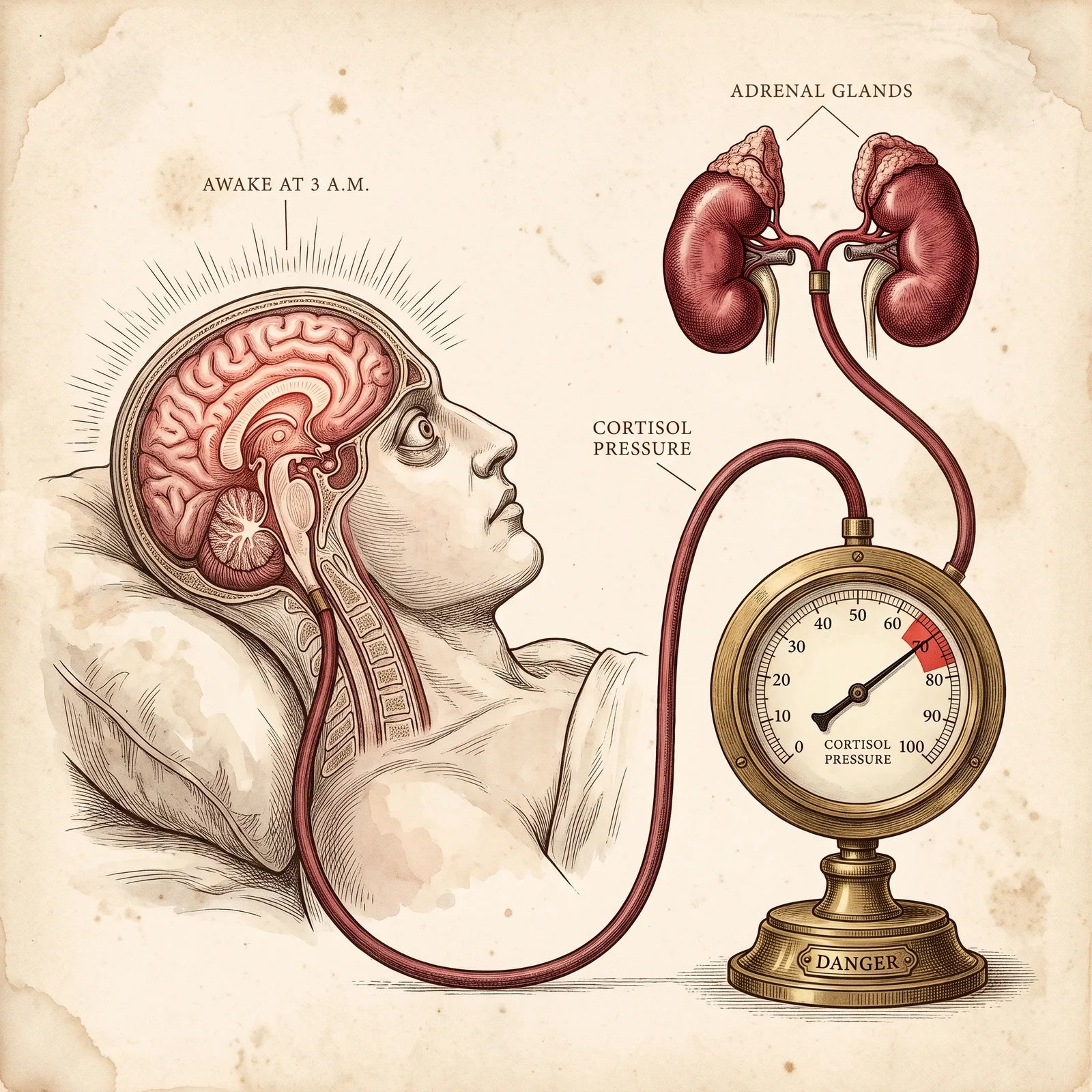
Cortisol is made by the adrenal glands, and the adrenal glands answer to the brain. A day spent under pressure, an evening spent answering one more email, an unresolved argument carried up the stairs: all of it keeps the stress axis primed, and a primed axis does not wait politely for morning.
This is why the 3am waking that comes with a busy season feels so different from an ordinary stir. You do not drift up. You arrive, wide awake, pulse audible, with the day's unfinished business already talking. The body has fired a burst of its wake-up chemistry several hours ahead of schedule, and everything downstream of it behaves as if it is time to get up.
What to do Judge your evenings by what they hand the small hours. The pressure you carry across the threshold at 11pm is the alarm setting you wake to at three.
You do not drift up. You arrive, wide awake, with the day's unfinished business already talking.
"Adrenal fatigue" is not a diagnosis, but the pattern is real
Search that 3am feeling and you will meet the phrase "adrenal fatigue", usually attached to something expensive. Honesty matters here: adrenal fatigue is not a recognised medical diagnosis, and anyone selling you a cure for it has skipped a step. If you are persistently exhausted, that is a conversation for your GP, not a checkout page.
What the phrase points at, though, is a real and common pattern: a stress system that has been asked to idle high for weeks, and a night that keeps fragmenting where the cortisol curve turns. You do not need a syndrome for that. You need evenings that stop rehearsing the day, and a night judged on hours two to seven.
What to do Skip anything that promises to fix your adrenal glands. Work on what reaches them: the state you are in for the last hour before bed.

The nightcap and the late snack invite the counter-surge
Two evening habits hand the small hours straight to the surge. The first is alcohol. A nightcap sedates you through the doorway, and then, as it is metabolised in the second half of the night, the body swings back the other way: lighter sleep, a faster pulse, and a waking that feels sprung rather than drifted into.
The second is the late sweet thing. A dessert or a sugary drink close to bed sends blood sugar up and then down, and the body's answer to a dip in the small hours is to release the very hormones you are trying to sleep through. Both habits feel like winding down. Both are lending the night to chemistry that wakes you.
What to do Keep alcohol and sugar well clear of the last two hours. If you want something warm in your hands at nine, make it something that is not borrowing against 3am.

Checking the clock teaches the alarm to repeat
What you do in the minute after surfacing decides more than the surfacing did. Reach for the phone, do the arithmetic about hours left, feel the flush of frustration, and you have answered a burst of readiness chemistry with three more reasons to be ready. The system notes that 3am is apparently important, and files it.
Bodies are superb at repeating whatever got attention. A waking that is met with light, worry and a glowing screen is a waking that has been rehearsed. A waking met with darkness and indifference is one the night can absorb.
What to do Turn the clock face away before bed and leave the phone out of reach. If you surface, stay in the dark and let it be boring. Boring is what tells the alarm it fired for nothing.
The alarm is set in the evening, not at 3am
By the time you are awake at three there is very little worth doing about it, which is exactly why 3am feels so helpless. The useful window was six hours earlier. The stress axis takes its instructions from how the day ends: the last screen, the last work thought, the last thing in the mug.
This is where a fixed wind-down earns its keep, and why the best one is small. One repeated signal at the same time every evening, a kettle, a mug, ten quiet minutes, tells the system the day is finished in the only language it reads: repetition. Grand nine-step routines die by Thursday. One boring signal survives the month, and the month is what the small hours listen to.
What to do Pick one wind-down signal you can repeat every night without deciding to, put it 30 to 60 minutes before bed, and defend it. That is the alarm you actually control.

What all six point at
One calm signal at the same time every evening, repeated until the body trusts it. That is why Hour Seven is a warm drink and not another capsule. A mug at 9pm is a signal you actually keep, and the right form of magnesium rides along with it, aimed at the second half of the night.
- 200mg magnesium bisglycinate per 7g scoop, not the cheap oxide
- Melatonin-free, so nothing to taper off
- Tart cherry, sugar-free, nothing to borrow against 3am
- Glycine 3,000mg, L-theanine 200mg, ashwagandha 300mg, zinc and B6, every dose printed
- 30 nights a pouch, one scoop in 200ml, 30 to 60 minutes before bed
Magnesium contributes to normal functioning of the nervous system, to normal psychological function and to the reduction of tiredness and fatigue.
From £44.99 for the two-pouch plan, 46% off and the option the page opens on, down to 67p a night on the three-pouch plan at 52% off. Every order ships with the 3D sleep mask free, worth £30. 60 days to change your mind.
See what's in it 🌙 4.7/5 from 129 reviews · Free UK delivery · 60-day promise
Hour Seven is a food supplement and is not a medicine. It is not intended to diagnose, treat or prevent any disease, and no claim is made that it changes cortisol or any hormone. Food supplements should not be used as a substitute for a varied and balanced diet or a healthy lifestyle. Anyone with persistent sleep problems or persistent exhaustion should speak to their GP.
200mg magnesium bisglycinate, tart cherry, melatonin-free
See what's in it