
Why ingredient studies do not prove a finished supplement blend
The short answer: studies on separate ingredients do not prove a finished supplement blend. A magnesium study, a glycine study and an L-theanine study test different interventions, often in different people and with different outcomes. Putting those ingredients into one pouch does not combine the studies into evidence for that exact product.
Reviewed 9 August 2026. Amounts and directions are live values, so this guide points at the product page rather than restating them.
Why adding citations is not the same as testing a blend
A multi-ingredient product is a new intervention. Its ingredient forms, amounts, ratios, directions, flavour system and co-ingredients may differ from the research being cited. The product may also be used by a population that was not represented in the studies.
Each citation can answer only the question it was designed to answer. One trial may examine 3 g of isolated glycine for a short period. Another may test a particular ashwagandha extract. A third may examine magnesium in older adults. These results do not automatically answer what happens when the ingredients are combined in a different finished formula.
The evidence-transfer ladder
| Level | What it can contribute | What remains unproven |
|---|---|---|
| Biological plausibility | A reason why an ingredient might be studied | A meaningful consumer outcome |
| Observational association | A relationship worth further investigation | Cause and effect |
| Single-ingredient controlled study | A result for that intervention, population and study design | The same result for a different form, amount or blend |
| Studies on several separate ingredients | Context for each tested ingredient | The combined effect of the finished formulation |
| Matched formula study | Evidence about a closely matched combination under tested conditions | Automatic equivalence if the retail formula, amount or directions differ |
| Finished-product randomised trial | Direct evidence about the tested product, comparator and population | A guarantee for every person or untested reformulation |
| Replicated body of direct evidence | Greater confidence when good studies are consistent and applicable | Certainty when important bias, imprecision or indirectness remains |
The ladder is not a points system. A randomised label does not make a study flawless, and a mechanistic study is not useless. Each design has a specific role and must be interpreted within that role.
Use the PICO check for directness
Evidence frameworks assess whether research matches the question being asked. A practical version uses population, intervention, comparator and outcome, often shortened to PICO.
- Population: Who took part, and do they resemble the people named in the claim?
- Intervention: Was the exact ingredient, form, amount, schedule and finished formula tested?
- Comparator: Was the product compared with placebo, usual care, another product or nothing?
- Outcome: Was the result a subjective rating, laboratory measure, wearable estimate or clinical endpoint?
Duration and setting should also be recorded. A one-night laboratory experiment and a twelve-week home study answer different questions. Greater mismatch means greater indirectness.
Eight transfer questions for an ingredient citation
- Is it the exact ingredient rather than a related compound or plant?
- Is the form or extract the same?
- Does the daily amount match?
- Does the timing and schedule match?
- Were the participants relevant to the intended audience?
- Was the duration long enough for the claim being discussed?
- Was the same outcome measured in a credible way?
- Was the ingredient tested alone or with co-interventions?
A numerical match on one field does not cancel mismatches on the others.
Why combinations require their own evidence
When ingredients are combined, the result is not necessarily the sum of separate study estimates. The finished blend can differ in directions, matrix, co-ingredients and user experience. The underlying studies may also use incompatible populations or outcome measures, so their numbers cannot simply be added.
This does not mean a combination is ineffective. It means the finished-product question remains unanswered until the combination is evaluated with an appropriate design.
What a finished-product trial still needs
Directness is important, but it is only one part of appraisal. A finished-product study should also be checked for:
- prospective registration and a clearly specified primary outcome;
- appropriate randomisation, allocation and blinding where feasible;
- a credible comparator;
- sample size and precision;
- missing data and participant flow;
- selective outcome reporting;
- adverse-event collection;
- funding, author roles and conflicts of interest;
- whether the tested product matches the product now sold.
CONSORT provides reporting guidance for randomised trials, while GRADE and Cochrane methods help reviewers judge certainty, bias and indirectness. Complete reporting improves appraisal, but reporting quality is not itself proof that a product works.
A worked evidence-transfer example
| Question | Fictional ingredient study | Fictional finished drink | Transfer concern |
|---|---|---|---|
| Intervention | Isolated Ingredient X | Ingredient X plus seven other ingredients | Combination not tested |
| Amount | 500 mg | 200 mg | Amount mismatch |
| Population | Adults over 65 with a diagnosed condition | General adult consumers | Population mismatch |
| Duration | Eight weeks | No finished-product trial | No matched duration |
| Outcome | Condition-specific clinical scale | General evening routine language | Outcome mismatch |
The study can be described as research on Ingredient X. It cannot responsibly be presented as proof that the fictional drink provides the study outcome.
Applying the boundary to Hour Seven
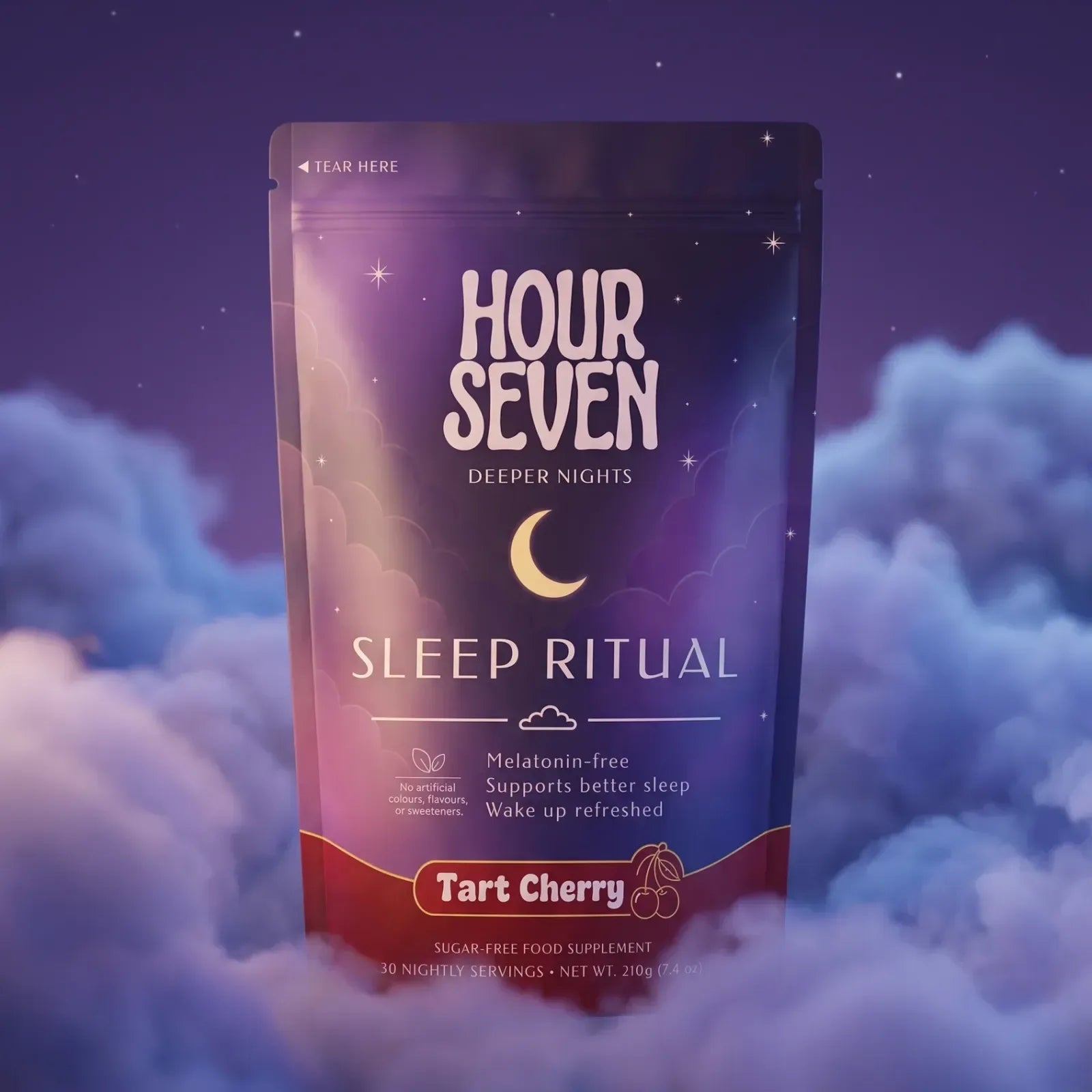
As checked against the physical pack on 9 August 2026, Hour Seven publishes a multi-ingredient formula containing glycine, magnesium bisglycinate, ashwagandha root extract, L-theanine, tart cherry juice powder, acacia fibre, zinc and vitamin B6. The live product page provides the current amounts, directions and cautions.
Those disclosures allow ingredient-by-ingredient comparison. They do not establish that Hour Seven reproduces the outcome of a glycine, magnesium, ashwagandha, L-theanine or tart cherry study. Several relevant citations remain ingredient context unless the finished Hour Seven formulation is tested in an appropriate study.
The current guide to magnesium drinks vs capsules applies the same boundary to format claims. Visit the Learning Hub for the source-led guide collection.
Frequently asked questions
If every ingredient has a study, does the blend have evidence?
The blend has ingredient context, but not necessarily finished-product evidence. The studies may use different forms, amounts, populations and outcomes, and they do not test the combined formula.
Does a matching ingredient amount prove transfer?
No. Amount is one field. Form, schedule, population, comparator, duration, outcome and co-ingredients also matter.
Is a finished-product randomised trial always conclusive?
No. It is more direct for the tested product question, but risk of bias, sample size, precision, missing data, reporting and applicability still require appraisal.
Can a company responsibly discuss ingredient research?
Yes. Identify the exact study intervention and outcome, state meaningful limitations, and make clear that the research is not proof of an untested finished product.
What happens if the retail formula changes after a trial?
The evidence match must be reassessed. A trial on an earlier formulation does not automatically establish the effect of a changed formula, amount or direction.